Lori Duffy Foster
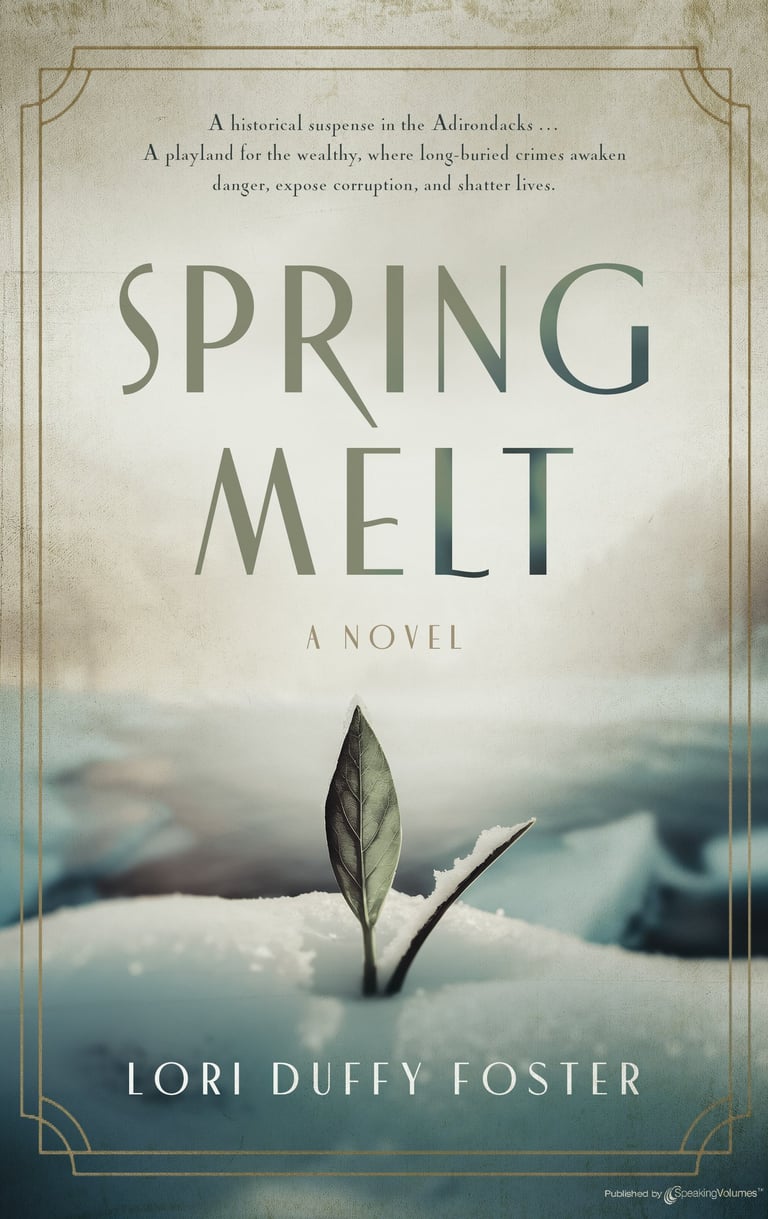
A historical suspense in the Adirondacks …
A playland for the wealthy, where long-buried crimes awaken danger, expose corruption and shatter lives.
Now available !
Spring Melt
As a doctor’s wife in a thriving Adirondack village in the 1920s, Ella Devine seems to have an ideal life. Her husband grew rich catering to New York City socialites who wanted to hide their TB diagnoses from their friends. Their marriage is devoid of emotion, but so is she, having learned long ago to quietly accept whatever life offers. But all that changes when three men are charged with a nineteen-year-old murder, and the long-buried crime that shaped Ella’s childhood is exposed.
SPRING MELT draws on the rich and fascinating history of the Adirondacks, where hikers who see only low hills and lush vegetation fail to perceive the hidden dangers and lose their lives by stepping two feet off the trail. Since the late 1800s, the wilderness that is the Adirondacks has been both a frontier to be conquered only by the hardiest of humans and a playland for the wealthy. When these two worlds collide, the resulting explosion can be fatal.
SPRING MELT is a gripping courtroom drama where every truth feels like a thin layer of ice—beautiful, fragile, and one step from cracking wide open. Lori Duffy Foster builds tension with the quiet inevitability of rising water, until everything breaks loose in the final verdict.
—Jamie Ford, New York Times bestselling author of The Many Daughters of Afong Moy
Order now!
"SPRING MELT is a gripping courtroom drama where every truth feels like a thin layer of ice—beautiful, fragile, and one step from cracking wide open. Lori Duffy Foster builds tension with the quiet inevitability of rising water, until everything breaks loose in the final verdict." —Jamie Ford, New York Times bestselling author of The Many Daughters of Afong Moy
"Lori Duffy Foster is a master of suspense and courtroom details, having worked as a crime reporter herself. Adding to the appeal of her novel are the lush descriptions of the Adirondacks, beautiful yet potentially dangerous due to the dense vegetation. It’s not uncommon for hikers to stray slightly from the trail in the wilderness and be lost forever. After Ella returns to walking the hills and lakes, she begins keeping a journal of what she sees, smells, and feels, discovering that writing helps her come into herself after years of being emotionally dulled by repressed pain. Toward the end, plot twists catch us by surprise, increasing the dramatic effect of Spring Melt. Recommended." - Jinny Webber, Historical Novel Society
Author Lori Duffy Foster has passionately and with intense detail shared the bounty and dangers of the Adirondacks, leaving any reader wanting a taste of this wilderness. Characters are described with phenomenal insight, and their growth is strongly evident. A rich history set in the 1920s, during the Prohibition of alcohol, drives the pacing forward, making for an emotionally charged read. The sense of family is evident in the lumberjacks' relationships, not only with each other but with the surrounding land as well. I loved the themes of hope, justice, and forgiving acceptance saturating these pages, as well as the narrative from the perspectives of the different characters. The author's writing style truly captured the essence of this story. For an emotional and suspenseful courtroom drama, Spring Melt is a must-read that will not disappoint fans of the genre. - Ronél Steyn for Readers’ Favorite
"Told from multiple perspectives, this was outstanding in every way. I HIGHLY RECOMMEND this book, and although I have no personal knowledge of the Adirondacks, I can honestly say I feel as though I've now been there." - Merissa, ArchaeoLibrarian - I Dig Good Books
“As events move within and outside of the courtroom, Lori Duffy Foster weaves a delicate dance between truth, crime, and victims that keeps readers involved and guessing about motivations, outcomes, and long-kept secrets. …
Librarians and readers will appreciate how the shocking series of revelations unfolds; the compelling nature of how all characters are fully developed with contrasting motivations and feelings about crime, justice, and survival; and how the mystery deepens and develops thanks to probes both within and outside the courtroom.
Book clubs dedicated to courtroom dramas that arrive with a sense of place, history, and purpose will especially appreciate how Spring Melt flavors its suspense with elements of psychological and social revelation in a manner that will encourage avid discussions on many levels.” – D. Donovan, Senior Reviewer, Midwest Book Review
"SPRING MELT is life-affirming, presenting a protagonist who is given a second chance to experience and enjoy life. Foster writes with sensitivity and maturity. This is a thoughtful and nuanced story, encouraging the reader’s engagement with the issues it raises. It also presents us with an ethical question: Can murder be justified when the perpetrator has escaped justice himself? Lori Duffy Foster has excelled herself. I loved this book!" – Laraine Stephens, author of the Reggie da Costa Mysteries
"SPRING MELT is a riveting story of justice, forgiveness, and redemption, in which revelations about past crimes and long-buried secrets unfold with nail-biting intensity. The layered narrative is a high-stakes courtroom drama that is also a thriller, as well as a coming-of-age story for the woman at the center of the conflict. As evidence piles up, for and against three men accused of murder, the personal bumps up against the political in ways that surprise, and yet, at the same time, feel inevitable.
SPRING MELT is not merely set in the Adirondacks. It’s that rare work in which the place and time are inextricably woven into the fabric of the tale. The descriptions are so vivid, I felt as if I knew, as well as the author, the landscape. Though the conclusion is deeply satisfying, I was sorry to turn the last page. It was that good." - Lori Robbins, award-winning author of the On Pointe Mysteries
"Ella Devine’s life in a quiet Adirondack town seems perfect. And although her marriage to a wealthy socialite doctor is cold and loveless, she is content. That is until an incident from her past, changes everything. Abandoned by her husband when her rape as a child comes to the surface after nineteen years, the three men who protected her then are charged with murdering her attacker.
Set in in lush atmosphere of beautiful mountains and lakes, this historical suspense novel is filled with rich details that make it vividly come to life. Details that former crime reporter Lori Duffy Foster turns into a captivating story you won’t want to put down." - Cathi Stoler, bestselling author of the Nick Donahue Adventures
"SPRING MELT by Lori Duffy Foster delivers a gripping mystery and courtroom drama steeped in Adirondack history and filled with characters whose grief, longing, and love leap off the page. The novel’s keen sense of place brings early-20th-century Saranac Lake vividly to life, and, as the trial at the center of the story unfolds, Foster deftly explores the many faces of justice—legal, moral, and personal—through a tapestry of relationships that have shaped each character’s life. A great read!" – Mally Becker, award-winning author of The Revolutionary War mysteries
"A quiet novel about how buried truths resurface slowly, altering lives not through drama, but through reckoning.
SPRING MELT moves with a deliberate stillness, attentive to the small fractures that appear when long held silences begin to loosen. The writing resists drama. There are no grand declarations, only the steady accumulation of moments that suggest how people endure rather than transform.
What stands out is the emotional economy. The author does not instruct us how to feel. Feelings surface indirectly through gesture, through what is left unsaid, through the spaces between scenes. The restraint is purposeful. It mirrors the interior lives of the characters who carry more than they articulate.
The prose is clean, almost austere. It values clarity over ornament. At times this distance may feel withholding, especially for readers who seek catharsis. But the strength of the book lies precisely there. It understands that meaning is not always found in resolution but in observation.
SPRING MELT is less concerned with answers than with attention. It watches carefully. And in doing so, it tells the truth it is willing to tell." - Books R&B
Praise for SPRING MELT

“A dark and suspenseful page-turner about obsession and betrayal, from a veteran storyteller. I couldn’t put it down. Highly recommended.”
— William Landay, bestselling author of All That Is Mine I Carry With Me
Most people have nightmares while they sleep. Carla Murphy awakens to find herself living one. Carla is excited when her best friend asks her to lunch and tells her to bring the baby. Rachel dislikes children and had been distant throughout Carla’s pregnancy. But Carla should have known that people don’t change that quickly. Lunch was a ruse. Carla emerges from a drug-induced slumber sealed in a room in Rachel’s basement with her son gone. Her best friend is no friend. She is obsessed with Carla’s husband and will kill them both if she doesn’t get what she wants. Carla has no choice. She must help Rachel, her confidant since childhood, seduce her husband or they all die, and her baby will be lost to her forever.
Available in paperback, ebook and audio!


A former crime reporter, Lori Duffy Foster was born and raised in the Adirondack Mountains of New York State, where a piece of her heart remains. Her previous novels include NEVER LET GO, a thriller, and the Lisa Jamison Mystery Series. Her books have been nominees or finalists for Agatha, Silver Falchion and Shamus awards. Lori is a member of Mystery Writers of America, Sisters in Crime, The Historical Novel Society, International Thriller Writers, The Finger Lakes Authors & Readers Experience and Pennwriters. After several moves about the country with her family, Lori now lives and writes in the hills of Northern Pennsylvania. Look out for two new novels in 2026 and 2027 from Speaking Volumes LLC, SPRING MELT, an historical courtroom drama, and NO STRANGER HERE, a thriller.